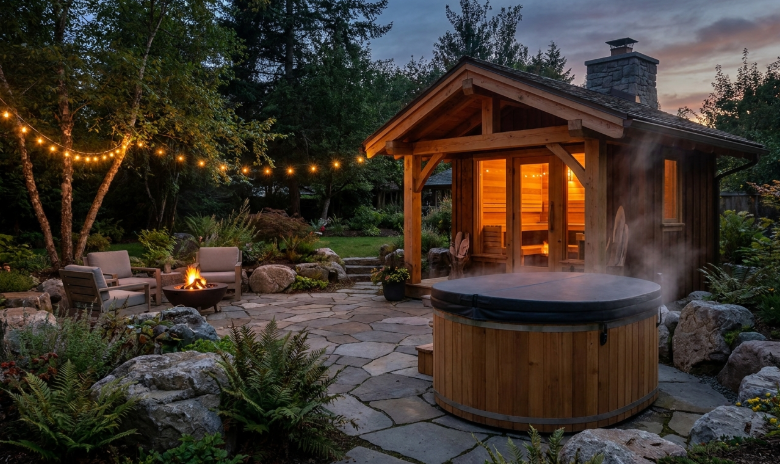
Western red cedar and heat-treated (thermally modified) hemlock are the two most common wood choices for a two-person sauna, and both perform well in a small cabin. Cedar costs more, roughly $9 to $14 per board foot installed, and brings natural rot resistance plus a familiar aroma. Thermally modified hemlock runs about $6 to $9 per board foot, matches cedar’s moisture resistance through a kiln process rather than natural oils, and gives a darker, more uniform look. Neither is the wrong answer; the choice usually comes down to budget, color preference, and whether the classic cedar scent matters to you.
What Makes Western Red Cedar the Default Choice?
Cedar has been the standard sauna wood for decades because it does something unusual for softwood: it resists rot and mold without any chemical treatment. The wood contains natural compounds, including thujaplicins, that make it inhospitable to fungus even when it goes through repeated cycles of heat and moisture. It is also low density, which means it does not retain heat the way denser hardwoods do, so a cedar bench stays comfortable to sit on bare-skinned even at 170 degrees Fahrenheit. In a two-person cabin, where both occupants are usually within arm’s reach of a wall, that low thermal mass matters more than it does in a larger room. The tradeoff is price. Cedar has gotten more expensive as old-growth stands have thinned, and a small two-person cabin using clear, tight-grain cedar for both walls and benches can add several hundred dollars to the total build cost compared with a lower-cost species.
See also: FusionX – Image to Video: Bring a Single Image to Life
![Free Access + Unlimited Calls! RunningHub Integrates FLUX.1Kontext [dev], Ushering in a New Era of Creation](https://cplemaire.org/wp-content/uploads/2025/07/Screenshot_2713-220x150.png)

What Is Heat-Treated Hemlock, and Why Has It Gotten Popular?
Thermally modified hemlock is regular Canadian or Appalachian hemlock that has been baked in a low-oxygen kiln at roughly 380 to 410 degrees Fahrenheit for several hours. That process caramelizes the sugars in the wood, changes its cell structure, and permanently reduces how much water the wood can absorb. The result is a wood that resists rot and warping almost as well as cedar, at a noticeably lower price, with a warm brown color that some buyers prefer over cedar’s lighter, more variable tone. Because the treatment is heat-based rather than chemical, it is safe for a sealed indoor environment and does not introduce anything that off-gasses at sauna temperatures. The main functional difference is aroma. Heat treatment drives off most of the wood’s natural resins along with the smell, so a hemlock cabin has a milder, toastier scent rather than cedar’s sharp, characteristic fragrance.
How Do the Two Woods Perform Inside a Tight Two-Person Footprint?
A typical two-person cabin runs about 4 by 5 feet to 5 by 5 feet of floor space with a 6.5 to 7 foot ceiling, so the walls, ceiling, and benches sit close to both occupants at all times. Dimensional stability matters more here than in a larger cabin, since even minor warping in a 4-foot panel can open a seam gap that leaks heat and lets moisture behind the boards. Cedar’s low density and natural oils keep it stable through repeated wet-dry cycles, and it has decades of field use to back that up. Thermally modified hemlock is engineered specifically to solve the stability problem through the kiln process, and in independent lumber-industry testing it shows dimensional movement close to cedar’s, sometimes slightly better, because the heat treatment reduces the wood’s equilibrium moisture content. Bench surface temperature is nearly identical between the two once both are dry; the difference shows up more in how the wood looks and smells than in how it performs.
What Does Each Wood Cost for a Small Two-Person Cabin?
Pricing varies by supplier, but a reasonable range for wall and bench paneling in a 4×5 or 5×5 foot cabin is $1,800 to $2,800 in clear cedar versus $1,300 to $2,000 in thermally modified hemlock, a gap of roughly $500 to $800 on the wood alone. That difference is meaningful on a compact build where total unit cost, heater included, often lands between $3,500 and $7,000. Buyers comparing sticker prices side by side can check current model pricing from the team at SweatDecks, which lists two-person cabins in both wood options with the species called out on each product page rather than buried in a spec sheet, which makes it easier to compare a hemlock quote from one retailer against a cedar quote from another on an apples-to-apples basis.
Which Wood Needs More Upkeep Over Time?
Both woods are low-maintenance compared with painted or stained surfaces, but they are not identical. Cedar benches can develop a slightly rougher, grayed surface after a year or two of regular sweat contact, and most owners do a light sanding pass once a year to keep the boards smooth. Thermally modified hemlock resists that graying because the kiln process already removed much of the material that would otherwise break down, so it typically needs sanding only once every two to three years. Neither wood should be treated with a household wood oil or varnish; both just need airflow between sessions, which is why every two-person cabin needs a low vent near the heater and a high vent near the ceiling.
Does the Wood Choice Change the Health Case for Regular Sauna Use?
No. The research behind sauna use as a wellness habit is built around heat exposure, frequency, and session duration, not wood species. A widely cited Finnish cohort study found that men who used a sauna four to seven times a week had lower rates of fatal cardiovascular events compared with men who used one once a week, an association that held after adjusting for other cardiovascular risk factors. A 2018 review in Mayo Clinic Proceedings summarized similar cardiovascular associations across a range of studies, and a 2023 follow-up review in the same journal looked at whether combining sauna use with other healthy habits added further benefit. None of that research distinguishes between a cedar cabin and a hemlock one, since the heat, not the paneling, is what the body responds to. Choose the wood based on budget, color, and scent, and treat the frequency of use as the variable that actually connects to the research.
So Which One Should You Buy?
If the classic sauna aroma and a lighter, traditional look matter to you and the budget allows it, cedar remains the safer long-term choice with the longest field track record. If you want a lower price point without giving up rot resistance or dimensional stability, thermally modified hemlock is a legitimate substitute, not a downgrade, and the savings can go toward a larger heater instead. Either way, confirm the supplier states the species and drying process explicitly; a vague listing that just says “premium sauna wood” is worth questioning before you order.
Frequently Asked Questions
Does heat-treated hemlock smell like a sauna the way cedar does? Not really. Cedar’s natural oils give off a distinct aroma when heated, while the kiln process used on hemlock drives off most of that scent, leaving a milder, toastier smell.
Is heat-treated hemlock as durable as cedar in a wet two-person cabin? Yes, for interior paneling and benches. The kiln process gives hemlock moisture resistance close to cedar’s natural resistance.
Can you mix cedar and hemlock in the same two-person cabin? Yes. Some builders use cedar for benches and hemlock for wall paneling to balance cost and feel, with no functional downside.
Does either wood need to be sealed or stained inside a sauna? No. Both are left unfinished so they can release moisture between sessions; sealants can off-gas at sauna temperatures.
References
- Cardiovascular and Other Health Benefits of Sauna Bathing: A Review of the Evidence, Mayo Clinic Proceedings, 2018
- Clinical Effects of Regular Dry Sauna Bathing: A Systematic Review, Evidence-Based Complementary and Alternative Medicine, 2018
- Does the Combination of Finnish Sauna Bathing and Other Lifestyle Factors Confer Additional Health Benefits? A Review of the Evidence, Mayo Clinic Proceedings, 2023
- Benefits and risks of sauna bathing, The American Journal of Medicine, 2001
By Megan Halloway